
Historic Solar System Image By Interstellar Voyager
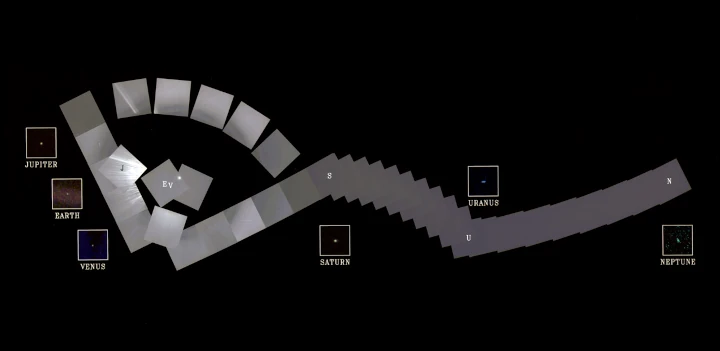
The Solar System “family portrait” is the final series of 60 images captured by NASA’s Voyager 1 that show six of our solar system’s planets. It remains the first and only time — so far — a spacecraft has attempted to photograph our home solar system.

The Family Portrait
In February 1990, Voyager 1 was speeding out of the solar system — beyond Neptune and about 3.7 billion miles (6 billion kilometers) from the Sun — when mission managers commanded it to look back toward home for a final time. It snapped a series of 60 images that were used to create the first “family portrait” of our solar system.
The image series contatains the famous image that would become known as the Pale Blue Dot, revealing Earth was a tiny dot within a scattered ray of sunlight. Voyager 1 was so far away that — from its vantage point — Earth was a crescent about a pixel.
In addition to Earth, Voyager 1 captured images of Neptune, Uranus, Saturn, Jupiter, and Venus. Mars was obscured by scattered sunlight bouncing around in the camera and Mercury was too close to the Sun, and dwarf planet Pluto was too tiny, too far away, and too dark to be detected.

Earth’s Messages To Space
Voyager Golden Records (1977): Voyager 1 and Voyager 2 carry 12-inch gold-plated copper records with images, Earth sounds, music, and greetings in 55 languages. Their covers include playback instructions, a pulsar map, and uranium-238 for age dating. Voyager 1 has now passed one light-day (about beyond 16 billion miles) from Earth. With The Golden Records. Inside the record are musical selections from different cultures and eras, and spoken greetings from Earth-people in fifty-five languages, and printed messages from President Carter and U.N. Secretary General Waldheim.
Each record is encased in a protective aluminum jacket, together with a cartridge and a needle. Instructions, in symbolic language, explain the origin of the spacecraft and indicate how the record is to be played. The 115 images are encoded in analog form
The image series contains the famous image that would become known as the Pale Blue Dot, revealing Earth was a tiny dot within a scattered ray of sunlight. “The family portrait is a symbol what NASA exploration is really about: Seeing our world in a new and bigger way,” Dr. Thomas H. Zurbuchen, Associate Administrator of NASA’s Science Mission Directorate, said in 2018.
Voyager 1’s final photographic assignment was to capture family portraits of the Sun and planets. In 1990, then-Planetary Society President and Voyager Imaging Team member Carl Sagan had been working for a decade to get these pictures taken. Voyager 1 had swung past Saturn in November 1980, and was flung by the ringed planet’s gravity high out of the plane of the ecliptic. On February 14, 1990, Voyager 1 aimed its cameras at a string of small colored dots clustered just to the right of the constellation Orion. The spacecraft was then 32 degrees above the ecliptic and nearly 6 billion kilometers from the Sun. It took 39 wide-angle views and 21 narrow-angle images. The narrow-angle camera, with a lens resembling a telephoto, took three consecutive images through colored filters of seven of the nine planets. This enabled image processors at the Jet Propulsion Laboratory to construct the colored inset portraits of the planets. Mars and Mercury were lost in the glare of the Sun, while Pluto (then still considered a planet) was too faint to be visible. Attribution: See Appendix Page.