Simply, Geoheritage Is The Intersection Of Music and Geography
Music intersects with geoheritage through geomusic and artistic performances that translate earth science, mineral resources, and geological sites into auditory experiences. Geoheritage refers to significant geological features, landforms, and processes that hold scientific, educational, cultural, or aesthetic value.
Geoheritage, – “Geomusic”
Geoheritage at play. “Undulating music waves” can refer to music that mimics the flowing, up-and-down motion of waves” Many tracks and albums are titled “Undulating Waves” and feature the sound of ocean waves, rain, or other natural phenomena mixed with instrumental music to create a relaxing atmosphere.
What Is Geoheritage
Music can be considered a part of geoheritage when it is directly inspired by or reflects geological features or processes. Music can be a powerful way to interpret and appreciate geoheritage, especially when it uses scientific data or geological concepts in its creation.
It is the connection between Earth’s geology and society. It is an informal term that can be applied to geologic features and landforms to illuminate the stories of how the geological landscape has shaped society and cultures. Geoheritage helps to illuminate cultural connections to the landscape (e.g., ancestral homelands, tools, and art), showcase both historic and modern examples of economic opportunities related to geology (e.g., mining, natural resources, geotourism/recreation, etc.)
Geoheritage as a source of artistic inspiration, which then becomes part of the music industry (e.g., songs about landscapes, sonification of geological data). The influence of physical geography on the development of regional music genres and cultural identity, which the music industry then promotes and commodifies through music tourism and festivals.
Geoheritage as Inspiration for Music
Geological landscapes and features have long served as muses for artists, poets, and musicians.
- Landscape-Inspired Music: Natural landforms, unique geological sites, and the general environment of a region can inspire musical compositions that convey a sense of place or emotion.
- Sonification of Geophysical Data: In a scientific and artistic collaboration, geophysicists and musicians have developed projects (like the EMusic project) to convert geological and seismic data into musical refrains. This “geomusic” can be used for:
- Educational tools to help people understand Earth science concepts and processes.
- Soundtracks for scientific documentaries or background music in museums and geoparks.
- Performances at outreach events to foster a “New Culture of Earth” and a renewed relationship with our planet.
Geography’s Influence on the Music Industry
The physical location and cultural geography play a significant role in shaping music genres and the music industry around them.
- Regional Genres, and Cultural Ecosystems.
- Music Tourism and Festivals: The music industry capitalizes on these geographic and cultural ties by promoting music tourism, festivals, and live concerts at iconic locations, which help transmit the region’s intangible heritage and can drive local economic development. This creates a link between the physical location (the geoheritage site or general landscape) and the cultural value that the music industry leverages.
- Filming Locations: The entertainment industry, including potentially music videos or films featuring musicians, emphasizes the importance of location in setting the tone and consciously capturing the essence of cultural geoheritage sites with integrity.
Georisonanze project utilizes the intersection of science and art to create a novel approach to science communication, aiming to foster greater public interest and engagement with Earth sciences and related environmental issues.
“Geomusic” the musical compositions created from scientific data related to climatic changes extracted from stratigraphic columns
Types of waves
- Mechanical waves: These require a medium, such as a solid, liquid, or gas, to travel through.
- Transverse waves: The disturbance is perpendicular to the direction of energy transfer, like a wave on a string.
- Longitudinal waves: The disturbance is parallel to the direction of energy transfer. Sound waves are an example, with compressions and rarefactions traveling through the air.
- Surface waves: These are a combination of both transverse and longitudinal motion, often seen in water waves where particles move in a circular path.
- Electromagnetic waves:These do not need a medium and can travel through a vacuum, like space. This category includes radio waves, microwaves, infrared, visible light, ultraviolet light, X-rays, and gamma rays
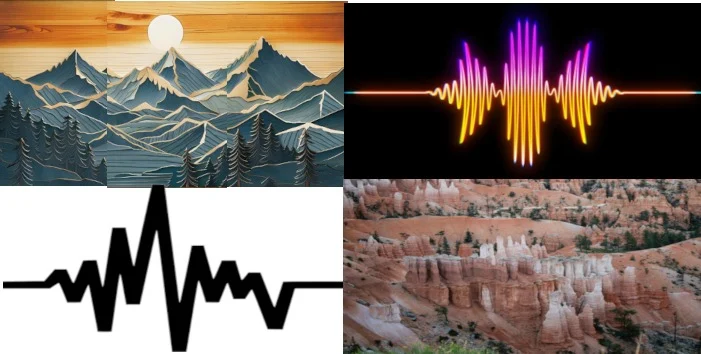
Images Reminds Of, And Inspiration As, Music Sound Waves – GeoMusic
Hoodoos. Fairy chimneys. Earth pyramids. Tent rocks. They have many different names, but these strange badland rock formations are one and the same, and they can be found in various iterations across the planet.
One of the best places to see hoodoos is in southern Utah’s Bryce Canyon National Park, which boasts a vibrant collection of natural “amphitheaters” filled with craggy columns composed of sedimentary rocks like sandstone and shale. A hoodoo (also called a tent rock, fairy chimney or earth pyramid) is a tall, thin spire of rock that protrudes from the bottom of an arid drainage basin or badland. Hoodoos, which may range from 1.5 to 45 metres (4.9 to 147.6 ft), typically consist of relatively soft rock topped by harder, less easily eroded stone that protects each column from the elements. They generally form within sedimentary rock and volcanic rock formations.Bernard Spragg. NZ from Christchurch, New Zealand, CC0, via Wikimedia Commons
Christian Ferrer, CC BY 4.0 https://creativecommons.org/licenses/by/4.0, via Wikimedia Commons