Welcome To A commitment to Music Art, The Physics of Sound, Instrument Acoustics, and How These Relate To Musical Expression.
The transition from non-living elements to living systems involves a multi-step journey of chemical evolution, molecular self-assembly, and thermodynamics.
1. The Core Building Blocks (CHONPS)
Stellar Origins: Carbon, nitrogen, oxygen, phosphorus, and sulfur were forged inside aging stars via nuclear fusion and scattered across space through stellar explosions.
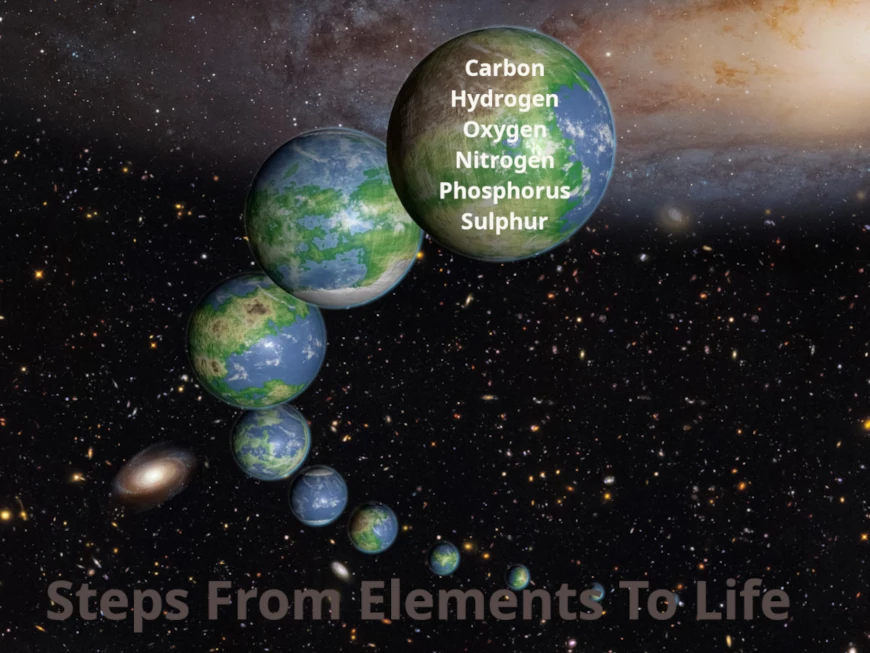
The Big Six: Nearly 99% of cellular mass in living organisms is composed of just six elements: Carbon, Hydrogen, Oxygen, Nitrogen, Phosphorus, and Sulfur (CHONPS).
Delivery & Synthesis: These elements combined into simple organic compounds through primordial energy sources like lightning, hydrothermal vents, or solar radiation. Recent studies suggest asteroids and direct chemical processes on early Earth—rather than fast-moving comets—played the primary delivery and synthesis roles.
2. From Molecules to Macromolecules
Prebiotic Chemistry: Simple compounds polymerized into complex biological polymers:
Amino acids linked into proteins.
Nucleotides formed RNA and DNA strands for information storage and replication.
Lipids spontaneously self-assembled into cell membranes and compartmentalized internal chemistry.
The RNA World: Early systems likely used RNA both to store genetic data and catalyze chemical reactions before DNA and specialized proteins took over specialized roles.
Chemiosmosis & Thermodynamics: Life operates far from thermodynamic equilibrium by dissipating environmental energy. Transition metal clusters in hydrothermal vents or mineral surfaces drove early redox reactions, establishing proton gradients and chemiosmosis.
Abiogenesis: Through processes of self-replication, autocatalysis, and natural selection acting on molecular variations, the first single-celled prokaryotic life emerged roughly 4.1 to 3.5 billion years ago
