
Site Navigation Pages Are Below
Welcome To A commitment to Music Art, The Physics of Sound, Instrument Acoustics, and How These Relate To Musical Expression.
One of the most important sources of income for independent musicians is the money you make through music publishing royalties.
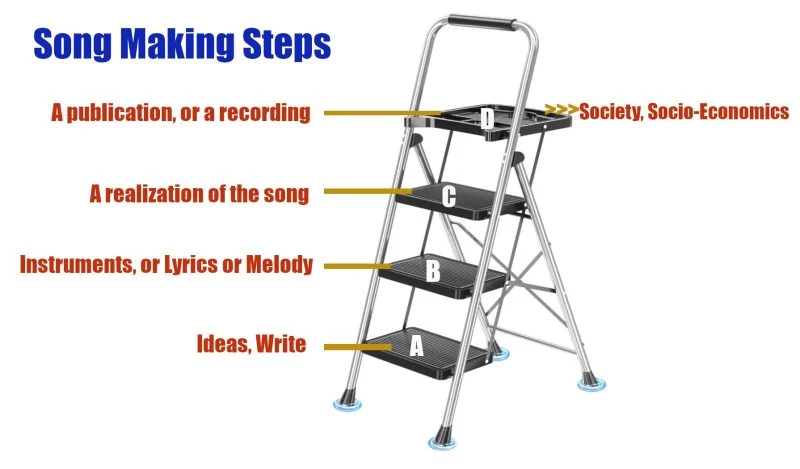
Steps Required For Making A Song.
The order that a song goes through from the making of the song to publishing. A song, either vocal or instrumental is as a musical work, an abstract entity that serves as an umbrella for many of its variations, versions, or renditions. When all of those key steps have been followed, then depending on the author if to, or not to move is to the next step. That next step would be a realization of the song in a performance, a publication, or a recording.
The production and distribution. Music production is the creative process of writing and recording the track, while publishing and distribution are the business and administrative steps of releasing it to the public.
Part 1: Production and recording
- Write the song. This begins with a moment of inspiration, and is the step where you create the lyrics, melody, rhythm, and chord structure.
- Produce a demo. Before a full-scale recording, a simple demo, or “song skeleton,” is created to guide the final production. This can be as simple as an acoustic version or a beat in a Digital Audio Workstation (DAW).
- Track and edit. The demo is built upon by recording each instrument and vocal layer separately. Multiple takes are often recorded, and editing software is used to select and assemble the best parts, fix errors, and perfect the timing and pitch.
- Mix the song. A mixing engineer balances all the individual audio tracks, adjusting levels, equalization (EQ), and compression. The goal is to make all the instruments and vocals work together cohesively.
- Master the track. This is the final and crucial step before release. Mastering engineers take the finished mix and make subtle adjustments to the overall sound to ensure it is polished, consistent, and ready for distribution across all formats and platforms.
Part 2: Publishing and distribution
- Secure copyrights. Registering your finished composition with the U.S. Copyright Office is an essential step to protect your exclusive rights to the work. It provides legal evidence of your ownership and is necessary to claim more substantial damages in case of infringement.
- Obtain ISRC and ISWC codes.
- An ISRC (International Standard Recording Code) is a unique 12-digit code for your specific sound recording. You can get this from your distributor.
- An ISWC (International Standard Musical Work Code) is for the underlying musical composition. These are used by publishing organizations to track royalties.
- Register with a Performance Rights Organization (PRO). A PRO, such as ASCAP or BMI, collects and distributes performance royalties to songwriters and publishers. These royalties are generated whenever your music is performed publicly, such as on the radio, in a live venue, or on streaming services.
- Choose a distributor. Digital distribution services like DistroKid, TuneCore, or CD Baby are the “bridge” that gets your music onto streaming platforms and online stores. They upload your song, handle metadata, and collect the recording royalties on your behalf.
- Plan and promote the release. After setting a release date, a marketing and promotion plan is put into action. This can involve leveraging social media, creating visual content, running advertising, pitching to music blogs and playlists, and setting up “pre-save” campaigns for streaming platforms.
- Release the song. On the designated day, your distributor delivers your music to all the digital service providers (DSPs), such as Spotify, Apple Music, and Amazon Music, making it publicly available.
- Collect royalties. Your distributor pays you the royalties for streams and downloads of the recording, while your PRO pays you the publishing royalties for the composition. It is also crucial to register with other organizations, such as SoundExchange, to collect all royalties owed
Expanded Final Stages
1. Streaming Royalties
Kicking off with the most obvious way to make money from your music – through music royalties and releasing it online, to all the major music platforms. Including Spotify, Apple Music, Deezer, Tidal and so on.
2. Music Publishing
Understanding how music publishing works can be a tricky business. But – it’s really important that you have a general grasp of it, to make sure you’re getting all the royalties you are owed as a musician.
3. Merchandise
Selling your own merchandise is another key way of generating income as an upcoming musician. You should invest in merch once you’ve started to gain a following and play regular shows or sets – as these events are where you’ll make the majority of your merch sales. But you can also sell merch via your online website or using an existing online store, such as Shopify.
4. Touring & Live Shows
Now that the world’s opened back up again (hooray!) live music and shows are one of the prime sources of income for musicians. – Ticket sales – On the door fees – Payment from the venue owner or promotor (if it’s a paid show)
5. Physical Sales
In today’s industry, income in the form of physical music sales – such as CDs, vinyl and cassettes – are certainly less prominent than before. But that’s not to say physical music sales aren’t still a viable income revenue for musicians and artists.
6. Sync Deals
Making money from music sync can be hard to do, but if you can crack it, you’re onto a winner.
Music sync is somewhat a whole other world. But for these purposes, in short – music sync, also known as “synchronising licensing”, enables artists to earn money by having their music featured in a form of visual media – so that’s movies, television shows or video games.
7. Brand Partnerships
Ever seen one of your favourite artists collaborating with a specific brand or product?
Well that’s essentially known as a brand partnership or endorsement deal. This is where the musician makes money as an endorser for a specific brand or product. The common types of brands/companies you might partner with as a musician include; – Musical instrument manufacturers – Clothing line – Social media app developers – Grooming product lines
8. Crowdfunding
Crowdfunding is essentially turning your followers and community into a sustainable form of funding for your projects. Whether that be buying new music equipment, bringing out a new album, or creating new artwork. It allows you to ask for some monetary support from your audience and fans – as an alternative to looking for a huge advance from one individual source (like a record label or loan). Which makes it an especially great option for independent musicians.
9. Music Libraries
A music library is essentially a curated collection of music-related materials, such as musical scores or audio recordings, that are only available for licensed and private use. Specifically made for ad agencies, videographers, indie filmmakers, YouTubers and other businesses with a license. Some of our favourite music libraries include:- Airbit – Jamendo Music – Marmoset – Artlist
10. Teach What You Know
If you’re a rapper, singer, composer or producer, all of these things can be sold to a younger artist in the form of online tutorials, workshops and vlogs. If you’re an instrumentalist, you could use your evenings and weekends to tutor an aspiring musician part-time.The bottom line is – you can sell your expertise to whoever else wants to learn and buy that knowledge.
How to master a song from start to finish. A Comprehensive Approach
https://www.izotope.com/community/blog/how-to-master-a-song-from-start-to-finish
….. The More You Know Series
Music Making