
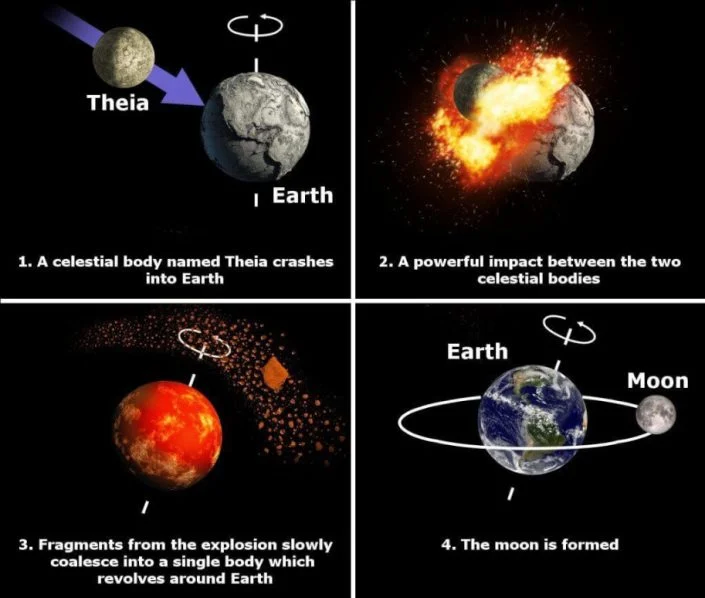
The Eartheia Paradigm refers to the Giant-Impact Hypothesis, a famous cosmic event where an ancient, Mars-sized planet named Theia collided with the proto-Earth approximately 4.5 billion years ago.
Earthiea Paradigm A Sample
….. The More You Know Series
Welcome To A commitment to Music Art, The Physics of Sound, Instrument Acoustics, and How These Relate To Musical Expression.
Music is indeed a powerful form of artistic expression, capable of conveying a wide range of emotions, ideas, and experiences that words alone may not fully capture. It transcends cultural and linguistic barriers, forging connections between individuals and allowing for profound emotional resonance
This Song Is A Dedication To Earth and Theia (Eartheia) Paradigm
“Theia & Earth’s Origin: “Theia” is a hypothetical ancient planet hypothesized to have existed in the early Solar System. According to the giant-impact hypothesis, Theia collided with the proto-Earth roughly 4.5 billion years ago, sending debris into space that eventually coalesced to form our Moon”
The Giant-Impact Hypothesis, a famous cosmic event where an ancient, Mars-sized planet named Theia collided with the proto-Earth approximately 4.5 billion years ago.
This cataclysmic event fundamentally reshaped our planet and is the leading scientific explanation for how the Moon was formed.
The Core Concepts of the Collision
The “Giant Impact”: Theia and early Earth were likely “neighbors” orbiting in the inner solar system closer to the Sun. Gravity eventually pulled them into a violent collision course.
Birth of the Moon: The sheer force of the impact vaporized Theia and blasted massive amounts of Earth’s early mantle into space. High-resolution simulations from organizations like NASA suggest this debris may have coalesced to form our Moon in just a matter of hours, rather than over centuries.
Leftovers Inside Earth: Scientists have discovered that Theia didn’t completely disappear. Two continent-sized, high-density “blobs” buried 1,800 miles deep near Earth’s core (known as large low-velocity provinces) are believed to be the buried relics of Theia’s iron-rich mantle that sank into our planet during the crash
Deeper Into The Key Facts About Theia
What it was: A hypothetical ancient, Mars-sized protoplanet in the early Solar System.
When it happened: Around 4.5 billion years ago.
The result: The giant-impact collision ejected debris that came together to form our Moon, and remnants of Theia may still exist deep inside Earth’s lower mantle.
Where the name comes from: It is named after the Greek titan Theia, who was the mother of the Moon goddess, Selene. “Thia” is simply a common misspelling.